by PushtoLearn
Determinantes em inglês - regras e exercícios
Exercícios sobre Determinantes Específicos e Gerais
Estes exercícios focam em Determinantes Específicos e Gerais
Determinantes Específicos
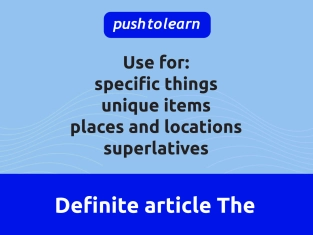
Determinantes específicos mostram que estamos falando de uma pessoa ou coisa específica que tanto o falante quanto o ouvinte conhecem.
Tipos de Determinantes Específicos
|
Tipo de Determinante |
Exemplos |
Exemplos de Frases |
|
The (artigo definido) |
the |
Can you pass me the salt? |
|
Possessivos |
my, your, his, her, its, our, their, whose |
Thank you for your help. |
|
Demonstrativos |
this, that, these, those |
Look at those beautiful flowers! |
Quando Usar Determinantes Específicos
1. Quando sabemos exatamente do que estamos falando:
-
The sun is shining today. (There is only one sun.)
-
I found the book you were looking for. (A specific book we already talked about.)
2. Quando usamos possessivos:
-
This is my jacket.
-
Whose phone is this?
3. Quando apontamos para algo com demonstrativos:
-
That car is very expensive.
-
These cookies taste amazing!
Erros Comuns com Determinantes Específicos
-
Can you pass me a salt? → (Incorreto)
-
Can you pass me the salt? → (Estamos falando de um sal específico.)
-
This flowers are beautiful. → (Incorreto)
-
These flowers are beautiful. → ("Flowers" está no plural, então usamos "these.")
Determinantes Gerais
Determinantes gerais são usados quando falamos de coisas em geral, e o ouvinte não sabe exatamente a que estamos nos referindo.
Tipos de Determinantes Gerais
|
Determinante |
Uso |
Exemplo |
|
a/an (artigo indefinido) |
Substantivos no singular |
A man came to the door. |
|
Sem determinante |
Substantivos no plural / incontáveis |
Milk is healthy. |
|
Any |
Substantivos no singular ou incontáveis (significando “todos”) |
Any child can learn English. |
|
Another |
Mais um, adicional |
Can I have another coffee? |
|
Other |
Forma plural de “another” |
I spoke to other students. |
Quando Usar Determinantes Gerais
1. Com substantivos no singular usando “a/an”:
-
She has a cat. (Any cat, not a specific one.)
-
I saw an interesting movie yesterday.
2. Com substantivos no plural e incontáveis (sem determinante):
-
Water is important for life. (Uncountable noun)
-
Dogs are friendly animals. (Plural noun)
3. Com “any” no sentido de “todos”:
-
Any student can participate in the contest. (All students)
-
With this key, you can open any door. (All doors)
4. Com “another” para algo adicional:
-
Would you like another cup of tea? (One more)
5. Com “other” para coisas adicionais no plural:
-
I met John and some other friends. (More friends, but not specific)
Erros Comuns com Determinantes Gerais
-
I saw a elephants at the zoo. → (Incorreto)
-
I saw an elephant at the zoo. → (Está no singular, então usamos “an”.)
-
Can I have other cup of coffee? → (Incorreto)
-
Can I have another cup of coffee? → (“Another” é usado com substantivos no singular.)
Comparando Determinantes Específicos e Gerais
|
Tipo |
Exemplos |
Específico ou Geral? |
|
I saw a dog in the park. |
A random dog |
Geral |
|
I saw the dog you were talking about. |
A known dog |
Específico |
|
This cake is delicious! |
A particular cake |
Específico |
|
Cakes are delicious. |
Cakes in general |
Geral |
|
I met another student. |
One more student |
Geral |
|
I met the student you told me about. |
A specific student |
Específico |