by PushtoLearn
Determiners: spiegazione esercizi
Contenuti
Esercizi sui Determiners (Specifici e Generali)
Questi esercizi si concentrano sui determinanti specifici e generali
Specific Determiners

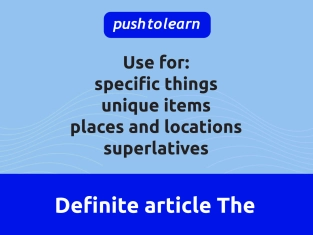
I determinanti specifici indicano che stiamo parlando di una persona o di una cosa particolare che sia il parlante sia l’ascoltatore conoscono.
Tipi di Specific Determiners
|
Tipo di determinante |
Esempi |
Esempi di frasi |
|
The (articolo determinativo) |
the |
Can you pass me the salt? |
|
Possessivi |
my, your, his, her, its, our, their, whose |
Thank you for your help. |
|
Dimostrativi |
this, that, these, those |
Look at those beautiful flowers! |
Quando usare i Specific Determiners
1. Quando sappiamo esattamente di cosa stiamo parlando:
-
The sun is shining today. (There is only one sun.)
-
I found the book you were looking for. (A specific book we already talked about.)
2. Quando si usano i possessivi:
-
This is my jacket.
-
Whose phone is this?
3. Quando si indica qualcosa con i dimostrativi:
-
That car is very expensive.
-
These cookies taste amazing!
Errori comuni con i Specific Determiners
-
Can you pass me a salt? → (Incorrect)
-
Can you pass me the salt? → (We are talking about a specific salt.)
-
This flowers are beautiful. → (Incorrect)
-
These flowers are beautiful. → ("Flowers" is plural, so we use "these.")
General Determiners
I determinanti generali si usano quando parliamo di cose in generale e l’ascoltatore non sa esattamente a cosa ci riferiamo.
Tipi di General Determiners
|
Determinante |
Uso |
Esempio |
|
a/an (articolo indeterminativo) |
Nomi singolari |
A man came to the door. |
|
Nessun determinante |
Nomi plurali / non numerabili |
Milk is healthy. |
|
Any |
Nomi singolari o non numerabili (significa “tutti”) |
Any child can learn English. |
|
Another |
Uno in più, aggiuntivo |
Can I have another coffee? |
|
Other |
Plurale di “another” |
I spoke to other students. |
Quando usare i General Determiners
1. Con i nomi singolari usando “a/an”:
-
She has a cat. (Any cat, not a specific one.)
-
I saw an interesting movie yesterday.
2. Con i nomi plurali e non numerabili (senza determinante):
-
Water is important for life. (Uncountable noun)
-
Dogs are friendly animals. (Plural noun)
3. Con “any” nel senso di “tutti”:
-
Any student can participate in the contest. (All students)
-
With this key, you can open any door. (All doors)
4. Con “another” per indicare qualcosa in più:
-
Would you like another cup of tea? (One more)
5. Con “other” per indicare altre cose al plurale:
-
I met John and some other friends. (More friends, but not specific)
Errori comuni con i General Determiners
-
I saw a elephants at the zoo. → (Incorrect)
-
I saw an elephant at the zoo. → (Singular, so use "an")
-
Can I have other cup of coffee? → (Incorrect)
-
Can I have another cup of coffee? → ("Another" is for singular nouns.)
Confronto tra determinanti specifici e generali
|
Tipo |
Esempi |
Specifico o Generale? |
|
I saw a dog in the park. |
A random dog |
General |
|
I saw the dog you were talking about. |
A known dog |
Specific |
|
This cake is delicious! |
A particular cake |
Specific |
|
Cakes are delicious. |
Cakes in general |
General |
|
I met another student. |
One more student |
General |
|
I met the student you told me about. |
A specific student |
Specific |