by PushtoLearn
Present Simple vs Present Continuous in Englishen
Inhaltsverzeichnis
Präsens Simple vs. Präsens Continuous – Übungen und Quiz
Diese Übungen konzentrieren sich auf die Verwendung von Präsens Simple und Präsens Continuous für verschiedene Handlungen.
Unterschiede zwischen Präsens Simple und Präsens Continuous
|
Zeitform |
Wann man sie verwendet |
Beispielsatz |
|
Präsens Simple |
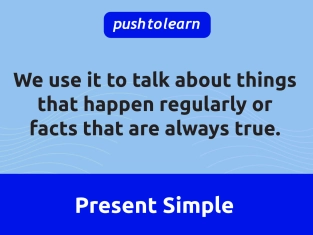
Für Gewohnheiten, Routinen und allgemeine Fakten |
I eat breakfast every morning. |
|
Präsens Continuous |
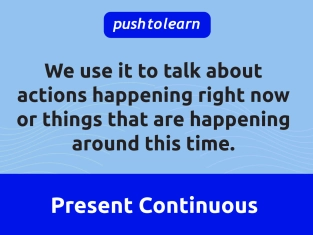
Für Handlungen, die gerade jetzt passieren, oder für vorübergehende Situationen |
I am eating breakfast right now. |
Wann man das Präsens Simple verwendet
-
Für Routinen und Gewohnheiten (Dinge, die man regelmäßig tut).
Example: I go to school every day.
-
Für Fakten und allgemeine Wahrheiten (Dinge, die immer wahr sind).
Example: Water boils at 100°C.
-
Für Zeitpläne oder feste Ereignisse.
Example: The bus leaves at 8:00 AM.
Zeitangaben, die mit dem Präsens Simple verwendet werden:
Every day, usually, often, sometimes, always:
-
I always wake up at 7 AM.
-
They often play soccer on Sundays.
Wann man das Präsens Continuous verwendet
-
Für Handlungen, die gerade jetzt passieren (in diesem Moment).
Example: I am studying English right now.
-
Für vorübergehende Handlungen oder Situationen (Dinge, die in dieser Zeit passieren, aber nicht immer).
Example: He is living in London for a few months.
-
Für Zukunftspläne (mit einer konkreten Zeit oder Verabredung).
Example: We are meeting our friends tonight.
Zeitangaben, die mit dem Präsens Continuous verwendet werden:
Now, right now, at the moment, today, this week:
-
She is reading a book right now.
-
We are traveling this week.
Wie man das Präsens Simple und das Präsens Continuous bildet
Struktur des Präsens Simple:
Subjekt + Grundform des Verbs (-s/-es bei he/she/it).
Example: She works at a hospital.
Struktur des Präsens Continuous:
Subjekt + am/is/are + Verb + -ing.
Example: They are playing in the park.
|
Subjekt |
Beispiel im Präsens Simple |
Beispiel im Präsens Continuous |
|
I |
I like pizza. |
I am eating pizza. |
|
He / She / It |
He plays football. |
He is playing football. |
|
We / You / They |
They watch TV. |
They are watching TV now. |
Wichtige Unterschiede und Beispiele
Routine vs. Jetzt:
Present Simple: She watches TV every evening. (A routine)
Present Continuous: She is watching TV right now. (Happening now)
Allgemeine Tatsache vs. vorübergehende Handlung:
Present Simple: He lives in Spain. (He lives there permanently)
Present Continuous: He is living in Spain for the summer. (Temporary situation)
Regelmäßige Handlung vs. Handlung im Moment:
Present Simple: I study English every day. (Habit)
Present Continuous: I am studying English right now. (Action happening at the moment)
Alltäglicher Gebrauch von Präsens Simple und Präsens Continuous
Present Simple: I brush my teeth every morning. (Routine)
Present Continuous: I am brushing my teeth now. (Happening right now)
Übungssätze
|
Präsens Simple |
Präsens Continuous |
|
I eat lunch at 12 PM every day. |
I am eating lunch right now. |
|
She goes to school by bus. |
She is going to school now. |
|
They play soccer on Sundays. |
They are playing soccer today. |