by PushtoLearn
Present Continuous im Englischen: Verwendung und Übungen
Übungen
Struktur
Wir bilden das Present Continuous mit be (am/is/are) + Verb + -ing.
I – am
He / She / It – is
We / You / They – are
Aussage
I am reading a book now.
She is cooking dinner.
They are playing football.
Verneinun
I’m not watching TV.
He isn’t listening to music.
We aren’t studying today.
Fragen
Am I speaking clearly?
Is she writing an email?
Are they waiting for the bus?
Fragewörter (W-Fragen):
What are you doing?
Where is he going?
Why are they shouting?
Rechtschreibregeln für -ing
Die meisten Verben: work – working, play → playing
Verben auf -e: make – making, write → writing
Kurzer Vokal + Konsonant: run – running, swim → swimming
Verben auf -ie: die → dying, lie – lying
Wann verwenden wir das Present Continuous?
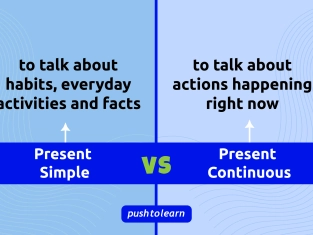
Handlungen, die jetzt passieren
Etwas ist im Moment des Sprechens im Gange.
He’s playing the guitar right now.
I’m talking on the phone at the moment.
They’re walking to school now.
Handlungen um jetzt herum (vorübergehend)
Nicht genau in diesem Moment, sondern in diesem Zeitraum.
She’s studying for exams these days.
My brother is looking for a new job.
I’m reading a very interesting novel this week.
Zukünftige Pläne (nahe Zukunft)
Mit einem Zeitwort der Zukunft (tonight, tomorrow, next week).
We’re having dinner with friends tonight.
They’re flying to Paris tomorrow.
I’m visiting my grandparents next Sunday.
Sich verändernde Situationen
Dinge, die sich entwickeln oder voranschreiten.
The weather is getting colder.
More people are learning English online.
This city is growing very quickly.
Ärgerliche Gewohnheiten (mit always/constantly)
Um Ärger oder Verärgerung über wiederholte Handlungen auszudrücken.
You’re always leaving your shoes in the hall!
He’s constantly forgetting his homework.
She’s always talking when I’m trying to read.
Zeitangaben mit dem Present Continuous
now
right now
at the moment
currently
today / this morning / this evening
these days
nowadays
Beispiele:
I’m working from home today.
She’s currently learning Spanish.
They’re having lunch right now.