by PushtoLearn
Present Continuous en anglais : usage et exercices
Exercices
Structure
Nous formons le Present Continuous avec be (am/is/are) + verbe + -ing.
I – am
He / She / It – is
We / You / They – are
Affirmative
I am reading a book now.
She is cooking dinner.
They are playing football.
Négative
I’m not watching TV.
He isn’t listening to music.
We aren’t studying today.
Questions
Am I speaking clearly?
Is she writing an email?
Are they waiting for the bus?
Mots interrogatifs (questions Wh-) :
What are you doing?
Where is he going?
Why are they shouting?
Règles d’orthographe pour -ing
La plupart des verbes : work – working, play → playing
Verbes se terminant par -e : make – making, write → writing
Voyelle courte + consonne : run – running, swim → swimming
Verbes se terminant par -ie : die → dying, lie – lying
Quand utilise-t-on le Present Continuous ?
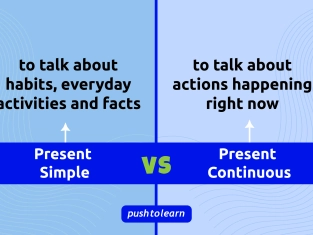
Actions qui se déroulent maintenant
Quelque chose est en cours au moment où l’on parle.
He’s playing the guitar right now.
I’m talking on the phone at the moment.
They’re walking to school now.
Actions autour du moment présent (temporaires)
Pas exactement à cet instant, mais pendant cette période.
She’s studying for exams these days.
My brother is looking for a new job.
I’m reading a very interesting novel this week.
Projets futurs (futur proche)
Avec un mot indiquant le futur (tonight, tomorrow, next week).
We’re having dinner with friends tonight.
They’re flying to Paris tomorrow.
I’m visiting my grandparents next Sunday.
Situations qui changent
Des choses qui se développent ou évoluent.
The weather is getting colder.
More people are learning English online.
This city is growing very quickly.
Habitudes agaçantes (avec always/constantly)
Pour montrer l’agacement ou la colère face à des actions répétées.
You’re always leaving your shoes in the hall!
He’s constantly forgetting his homework.
She’s always talking when I’m trying to read.
Expressions de temps avec le Present Continuous
now
right now
at the moment
currently
today / this morning / this evening
these days
nowadays
Exemples :
I’m working from home today.
She’s currently learning Spanish.
They’re having lunch right now.