by PushtoLearn
Future Simple: Verwendung und Übungen
Übungen
Formen
Das Future Simple wird mit will + Grundform des Verbs gebildet. Im älteren Englisch wurde shall mit I und we verwendet, aber heute benutzen wir normalerweise will für alle Personen.
Aussagesätze (Affirmative)
Subjekt + will + Verb
-
I will work tomorrow.
-
She will travel next week.
-
They will find the key tomorrow.
Kurzform: I’ll, you’ll, he’ll, usw.
Verneinung (Negative)
Subjekt + will not (won’t) + Verb
-
I will not go for a walk tomorrow. - I won’t go for a walk tomorrow.
-
He won’t buy this ring.
-
We won’t be late.
Fragen (Questions)
Will + Subjekt + Verb … ?
-
Will I go for a walk tomorrow?
-
Will my husband buy this ring?
-
Will we find the key tomorrow?
W-Fragen (Wh- questions):
-
Where will I go tomorrow?
-
What will he buy?
-
When will we meet?
Verwendung des Future Simple
Allgemeine zukünftige Handlungen. Zur Beschreibung von Handlungen, die einmalig, wiederholt oder in einer Abfolge stattfinden.
- He will come here tomorrow.
- They will go to the cinema, buy snacks, and watch a movie.
Vorhersagen und Annahmen. Um zu sagen, was wir denken, glauben oder erwarten, dass passieren wird.
- I think he will win the competition.
- I’m afraid she won’t come on time.
- Probably they will find a solution.
Versprechen, Hoffnungen und Drohungen
- I promise I will help you tomorrow.
- We hope he will enter the university.
- She swears she will be home in time.
Zukünftige Fakten (Dinge, die wir nicht ändern können)
- The sun will rise at 6 a.m.
- The storm will start tomorrow.
- Spring will come soon.
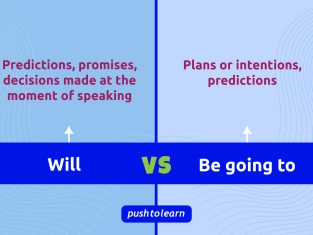
Spontane Entscheidungen. Entscheidungen, die im Moment des Sprechens getroffen werden.
- I’ll take this dress.
- We’ll go there right now!
- I’ll paint this table.
Zeitangaben mit dem Future Simple
tomorrow
the day after tomorrow
tonight
soon / later / as soon as …
next week / next month / next year
in two days / in a week / in three years