by PushtoLearn
Pronoms en anglais – liste
Table des matières
Exercices
Types de pronoms en anglais
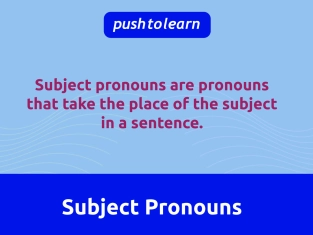
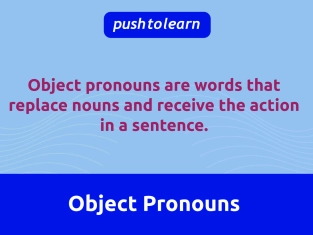
Pronoms personnels (Personal Pronouns)
Ces pronoms remplacent directement des personnes ou des choses.
-
I, you, he, she, it, we, they (subjects)
-
me, him, her, us, them (objects)
Examples:
-
I enjoy reading.
-
He is my cousin.
-
We met them at the museum.
Pronoms possessifs (Possessive Pronouns)
Indiquent la possession ou l’appartenance.
-
my, your, his, her, its, our, their (before nouns)
-
mine, yours, his, hers, ours, theirs (stand alone)
Examples:
-
This is my jacket.
-
That blue car is theirs.
Pronoms démonstratifs (Demonstrative Pronouns)
Désignent des choses spécifiques.
this, that, these, those
Examples:
-
This is my desk.
-
Those are old photographs.
Pronoms interrogatifs (Interrogative Pronouns)
Sont utilisés pour poser des questions.
who, whom, whose, what, which
Examples:
-
Who is your teacher?
-
Which book do you prefer?
Pronoms relatifs (Relative Pronouns)
Relient des propositions (informations supplémentaires dans une phrase).
who, whom, whose, which, that
Examples:
The woman who called you is outside.
This is the key that opens the door.
Pronoms indéfinis (Indefinite Pronouns)
Se réfèrent à des personnes ou des choses de manière générale (non spécifique).
someone, anyone, everyone, nobody, each, all, some, none, anything
Examples:
Someone left a message for you.
I don’t have any milk.
Pronoms réciproques (Reciprocal Pronouns)
Expriment une action ou une relation mutuelle.
each other, one another
Example:
The two friends wrote letters to each other.
Pronoms intensifs (Intensive Pronouns)
Sont utilisés pour mettre l’accent (mêmes formes que les pronoms réfléchis).
myself, yourself, himself, herself, itself, ourselves, themselves
Example:
The director signed the letter himself.
Pronoms réfléchis (Reflexive Pronouns)
Se réfèrent au sujet de la phrase.
myself, yourself, himself, herself, itself, ourselves, themselves
Examples:
She prepared the presentation herself.
Be careful, you might hurt yourself.
Erreurs courantes avec les pronoms
Incorrect: Me like chocolate.
Correct: I like chocolate.
Incorrect: Her is very nice.
Correct: She is very nice.
Incorrect: The dog wagged it’s tail.
Correct: The dog wagged its tail.
Tableau récapitulatif des pronoms
|
Type |
Examples |
Sentence Example |
|
Personal |
I, you, he, she, we, they |
They are in the garden. |
|
Possessive |
my, mine, yours, theirs |
That notebook is mine. |
|
Demonstrative |
this, that, these, those |
These are my new shoes. |
|
Interrogative |
who, what, which, whose |
Whose bag is on the table? |
|
Relative |
who, which, that, whose |
This is the student who won the prize. |
|
Indefinite |
some, any, nobody, all |
Nobody was in the library. |
|
Reciprocal |
each other, one another |
The players congratulated each other. |
|
Reflexive |
myself, herself, ourselves |
He introduced himself politely. |
|
Intensive |
myself, himself, themselves |
She solved the problem herself. |