by PushtoLearn
Infinitive Verbs
Table of Contents
Infinitive Verbs Exercises
These exercises focus on Infinitive Verbs.
🔤 What is an Infinitive?
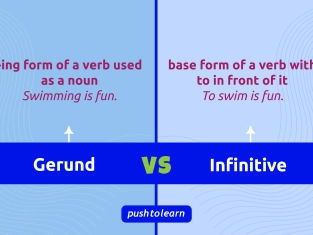
An infinitive = "to" + base verb
🔹 Examples:
➡️ to eat 🍎
➡️ to sleep 😴
➡️ to dance 💃
➡️ to study 📖
➡️ to play 🎸
📌 Tip: The infinitive is not a conjugated verb. It stays the same for all subjects.

1️⃣ Verb + To + Infinitive
Some verbs are followed by an infinitive with "to."
🔹 Examples:
✅ I decided to go home as soon as possible.
✅ We all wanted to have more English classes.
Common Verbs That Take "To + Infinitive"
|
Verbs of Thinking & Feeling |
Verbs of Saying |
Other Verbs |
|
choose |
agree |
arrange |
|
decide |
promise |
attempt |
|
expect |
refuse |
fail |
|
forget |
threaten |
help |
|
hate |
manage |
|
|
hope |
tend |
|
|
intend |
try |
|
|
learn |
||
|
like |
||
|
love |
||
|
mean |
||
|
plan |
||
|
prefer |
||
|
remember |
||
|
want |
||
|
would like/love |
📌 Tip: If you use these verbs before another verb, use "to + infinitive."
2️⃣ Infinitives After Adjectives
It’s + adjective + infinitive
🔹 Examples:
✅ It’s hard to learn Chinese.
✅ It’s nice to meet you.
✅ It’s fun to play soccer.
📌 Tip: Use infinitives after "It’s" + adjectives (easy, difficult, important, nice, fun, etc.).
3️⃣ Infinitives of Purpose (Answering "Why?")
Use an infinitive to explain WHY something is done.
🔹 Examples:
✅ I exercise to stay healthy. 🏃
✅ She studies to pass the exam. 🎓
✅ He left early to catch the bus. 🚌
📌 Tip: Instead of "for + verb (-ing)," use "to + verb" for purpose.
❌ I exercise for staying healthy. (Incorrect ❌)
✅ I exercise to stay healthy. (Correct ✅)
4️⃣ "Make" and "Let" + Bare Infinitive
Some verbs, like "make" and "let," are followed by a bare infinitive (infinitive without "to").
🔹 Examples:
✅ My mom made me clean my room. (Not "to clean")
✅ She let me borrow her car. (Not "to borrow")
Structure:
👉 Make + object + base verb
👉 Let + object + base verb
🔹 More Examples:
✅ The teacher made us write an essay.
✅ They let us leave early.
📌 Tip: "Make" means force or require someone to do something.
📌 Tip: "Let" means allow or permit someone to do something.
❌ Common Mistakes with Infinitives
|
❌ Incorrect |
✅ Correct |
📢 Why? |
|
I enjoy to swim. |
I enjoy swimming. |
"Enjoy" takes a gerund, not an infinitive. |
|
She wants go home. |
She wants to go home. |
Always use "to" before the verb. |
|
He is happy help. |
He is happy to help. |
Use "to" after adjectives. |
|
I need study more. |
I need to study more. |
"Need" takes an infinitive. |
|
My dad let me to drive the car. |
My dad let me drive the car. |
"Let" takes a bare infinitive. |
📌 Tip: Remember which verbs take infinitives and which take gerunds!
📝 Example Sentences with Infinitives
🔹 Verb + To + Infinitive
✅ I hope to travel next year.
✅ She promised to call me.
🔹 Infinitives After Adjectives
✅ It’s important to be on time.
✅ He is excited to start his new job.
🔹 Infinitives for Purpose
✅ I went to the gym to exercise.
✅ She studies hard to get good grades.
🔹 Make & Let + Bare Infinitive
✅ My parents made me apologize.
✅ She let me use her phone.
📌 Fun Fact: The longest English phrase with only infinitives is "to be or not to be" from Hamlet! 🎭
FAQs About Infinitive Verbs
What is an infinitive verb?
➡️ An infinitive is the base form of a verb with "to" (e.g., "to eat," "to go").
How do I know when to use an infinitive or a gerund?
➡️ Some verbs take infinitives (want to go), some take gerunds (enjoy going), and some can take both.
Can an infinitive be the subject of a sentence?
➡️ Yes! Example: "To learn English is fun."
What is the difference between "to go" and "going"?
➡️ "To go" is an infinitive (e.g., "I want to go").
➡️ "Going" is a gerund (e.g., "I enjoy going").
Why do "make" and "let" use bare infinitives?
➡️ Because in English, some verbs (like "make" and "let") drop "to" before the verb.
➡️ Example: "My boss made me stay late." (Not "to stay").